


This Day in History: John Paul Jones captures HMS Drake
Updated: Sep 22
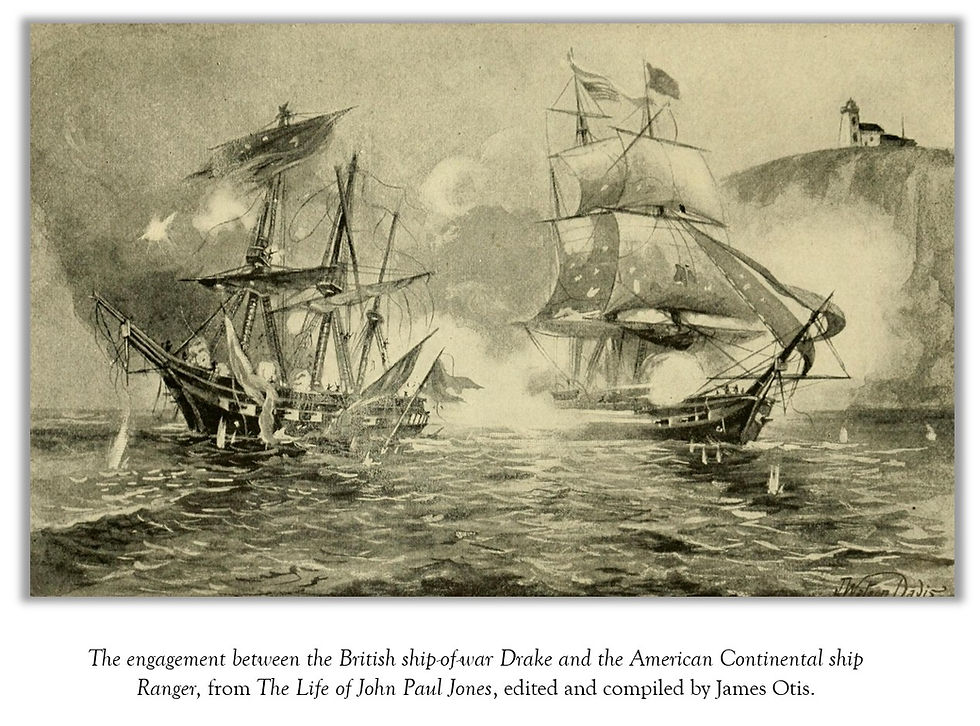
On this day in 1778, American naval captain John Paul Jones captures HMS Drake—and he does it in British waters. He would soon return to a French port with the captured vessel and American colors flying above inverted British ones.
The capture was welcome news, to say the least. Jones had been having a generally difficult time. He was then commanding the Continental Navy ship Ranger with the stated mission of “distressing the Enemies of the United States by Sea, or otherwise . . . .”
A near-mutinous crew was one source of trouble. His crew wanted to plunder instead.
Another sore spot came on April 21 when he entered the harbor at Carrickfergus hoping to engage Drake. Contrary winds hindered him, and he’d been forced to abandon the attempt. He turned his attention to harassing British ports.
On the night of April 22-23, Jones hit a port at Whitehaven. It was crowded, with hundreds of ships lying together. His plan was to disable the cannons in the forts, then set fire to the ships.
Things didn’t go as well as planned due to his uncooperative crew. Some British cannons were disabled, and a few ships were set afire, but not much more was accomplished. Instead, many in the crew simply went ashore and got drunk in a local tavern.
Jones needed another plan.
He next attempted to kidnap one of the local gentry, the Earl of Selkirk. If Selkirk were captured, perhaps Jones could prompt the King into “a general and fair exchange of prisoners.”
Within hours of leaving Whitehaven, Jones and a small squad of his men went ashore near the Earl’s castle. Unfortunately, the Earl was not at home, but Jones’s men finally obtained some of the plunder they’d so desperately wanted: The Countess handed over some of her silver.
By the morning of the 24th, Jones was in the North Channel between Scotland and Ireland. He noted HMS Drake leaving her harbor. The British Captain, George Burdon, had also seen Ranger, but he at first thought Ranger was a merchant ship. He sent a small boat with an officer, a gunner, and six crew toward Ranger, hoping to investigate.
You can imagine the surprise of those British sailors when they came alongside Ranger, only to be captured.
Burdon realized his mistake when his men never returned. He turned his vessel toward Ranger, finally coming within hailing distance.
“The Drake hoisted English colors,” Jones later wrote, “and at the same instant the American stars were displayed on board the Ranger.” As Burdon demanded to know which ship he hailed, Jones taunted him, noting that the “sun was now little more than an hour from setting, it was therefore time to begin.”
He launched a broadside, starting a “warm, close, and obstinate” action that would last just over an hour. The British vessel was struggling. Some of her guns had become unstable, making them less accurate. By contrast, the American crew was firing at a quick clip.
When the British surrendered, they had to do so by waving a hat and screaming over the noise. They couldn’t lower their colors because the flag had been ripped to shreds. Forty-two men aboard Drake had been lost, including the mortally wounded Captain.
By contrast, Americans had lost only two killed. It was one of the Continental Navy’s first major naval victories against Great Britain. Needless to say, Jones was well on his way to becoming a naval legend.
“Every officer in our Navy should know by heart the deeds of John Paul Jones,” Theodore Roosevelt once said. “Every officer in our Navy should feel in each fiber of his being an eager desire to emulate the energy, the professional capacity, the indomitable determination and dauntless scorn of death which marked John Paul Jones above all his fellows.”

Primary Sources:
Address by President Theodore Roosevelt the interment of John Paul Jones at the US Naval Academy at Annapolis on April 24, 1906 (reprinted HERE)
Christy Gabe, The Ranger and the Drake: John Paul Jones Brings the American Revolution to Britain (War History Online; Aug 21, 2016)
Dr. Lincoln Lorenz, The Bicentennial of John Paul Jones (USNI July 1947 Proceedings) (reprinted HERE)
Jonathan Feld, John Paul Jones’s Locker: The Mutinous Men of the Continental Ship Ranger and the Confinement of Lieutenant Thomas Simpson (Naval History and Heritage Command; 2019) (publication info HERE)
Letter from John Paul Jones to the American Commissioners (May 9, 1778) (noted HERE)
Louis H. Bolander, The Log of the Ranger (USNI; February 1936 Proceedings) (reprinted HERE)
Ranger vs HMS Drake (Naval History and Heritage Command)
Robert W. Neeser, Historic Ships of the Navy—Ranger (March 1929 USNI Proceedings) (reprinted HERE)
The life of John Paul Jones: written from original letters and manuscripts in possession of his relatives, and from the collection prepared by John Henry Sherburne: together with Chevalier Jones’ own account of the campaign of the Liman (James Otis ed. 1905)
Comments