


This Day in History: Operation Shingle
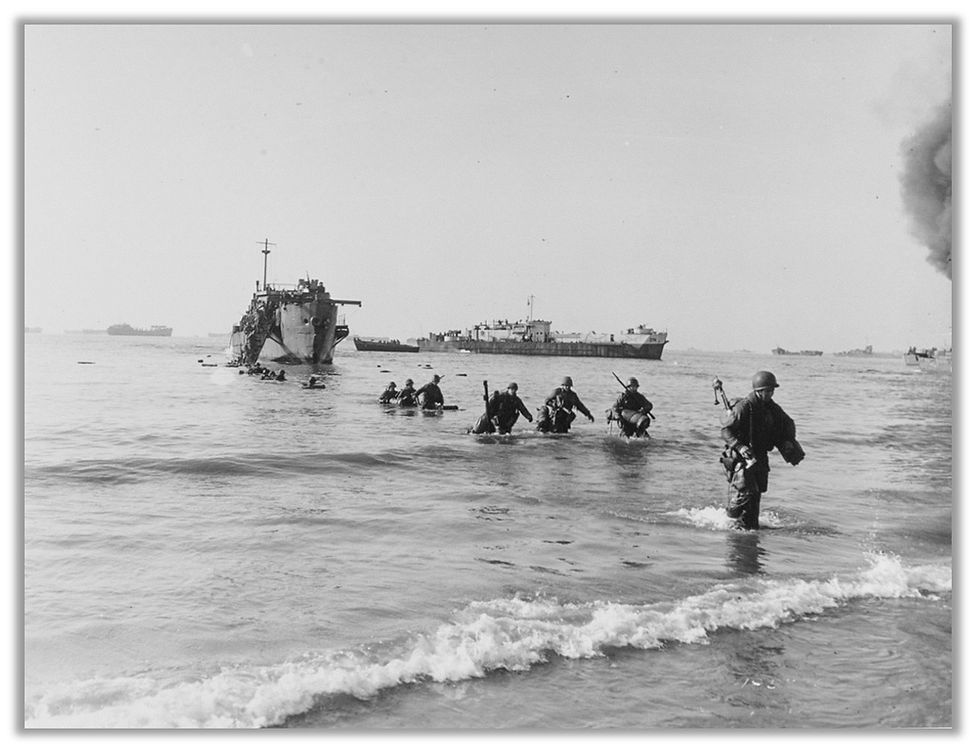
On this day in 1944, Allied forces come ashore in “Operation Shingle,” an amphibious landing near Anzio, Italy.
Military leaders were determined to break Nazi Germany’s hold on Italy.
It had already been a difficult winter. American and British forces had landed in southern Italy in September, intending to work their way north towards Rome, but the effort had turned into a long, hard slog.
Much of the trouble came from a German defense barrier known as the Gustav Line, which stretched across the Italian peninsula.
“Enemy engineers had reinforced the natural mountain defenses,” a U.S. Army study explains, “with an elaborate network of pillboxes, bunkers, and mine fields. . . . By late October 1943 it was evident that the Germans intended to compel the Allied forces to fight a slow, costly battle up the peninsula.”
Something had to be done.
Were there enough resources to bypass the Gustav line with another amphibious landing further north? If such a landing were made, would Germany be forced to move its own resources away from the Gustav line to meet the new threat?
Allied leaders certainly hoped so. An invasion was planned for late 1943 but then canceled due to a shortage of landing craft. Several weeks later, the idea was revived. The new plan called for American and British troops to land near the coastal cities of Anzio and Nettuno.
The invasion began just after midnight on January 22. At first, everything was going well as our boys went ashore with relatively little opposition.
Fortunately, the Germans had not anticipated the move.
Our troops established a beachhead and gained control of Anzio’s port, but Allied commanders have been criticized for what came next: British General Sir Harold Alexander felt that troops should continue from Anzio, seizing the Alban Hills just south of Rome. Yet American General Mark Clark and Lt. General John P. Lucas disagreed. They felt the Hills were too far away and remained concerned about whether they had enough men.
In the end, no attempt at the Hills was made: Military leaders instead waited for more troops to land. Did that decision affect what followed?
The Germans were quick to regroup after their initial surprise. They counterattacked, and Allied forces soon found themselves cornered in the beachhead.
Worse, the Germans even managed to keep the Gustav Line reinforced.
The weeks that followed were part battle, part stalemate. “Every day the German Luftwaffe would strafe and bomb the port,” one U.S. Army combat engineer said, “every day we’d rebuild and resurface the docks and the roads leading to the docks. Such was the tit-for-tat, hold-your-ground fighting that was the essence of a long period of entrenchment at Anzio.”
War correspondent Ernie Pyle agreed. “Some days they shelled us hard, and some days hours would go by without a single shell coming over,” he wrote. “Yet nobody was wholly safe, and anybody who said he had been around Anzio two days without having a shell hit within a hundred yards of him was just bragging.”
It must have felt like all was lost. Fortunately, a May offensive finally enabled Allied forces to break through the Gustav line. The two sides linked up. Rome would be taken on June 4.
“The Germans threw attack after attack against the beachhead in an effort to drive the landing force into the sea. . . .[Fifth Army troops] rose to the test,” the U.S. Army study concludes. “Hemmed in by numerically superior enemy forces, they held their beachhead, fought off every enemy attack, and then built up a powerful striking force which spearheaded Fifth Army’s triumphant entry into Rome.”
Overcoming a difficult stalemate through sheer determination, perseverance, and grit. How wonderfully AMERICAN.
Enjoyed this post? More World War II
stories can be found on my website, HERE.
Primary Sources:
1stLt John J. Tharp, Anzio-A Sedentary Affair (Marine Corps Assoc.; Sept. 1, 1984) (reprinted HERE)
Anzio Beachhead: 22 January—25 May (Center of Military History; U.S. Army; 1990)
Anzio: The Invasion That Almost Failed (Imperial War Museum)
Dwight Jon Zimmerman, Churchill’s Blunder: Anzio (Defense Media Network)
Operation Shingle: Landing at Anzio, Italy (Naval History and Heritage Command)
The Impact of Operation Shingle during World War II (American Battle Monuments Commission; January 22, 2022)
VADM James Foggo, Remembering the Battle of Anzio: A Sixth Fleet Staff Ride (U.S. Naval Institute Blog; May 28, 2016)
Comments