


This Day in History: Battle of Delaware Bay
On this day in 1782, a small American sloop faces off against HMS General Monk. The sloop’s captain was just 22 years old. He was outgunned and outmanned.
Naturally, he outwitted—then defeated—the British in a mere 30 minutes.
“This action has been justly deemed one of the most brilliant that ever occurred under the American flag,” historian James Fenimore Cooper concludes. “It was fought in the presence of a vastly superior force . . . [the ship taken was] superior to her conqueror.”
The conflict wouldn’t have happened but for Loyalist privateers who’d been raiding merchant ships near Delaware Bay early in 1782.
The merchants sought help.
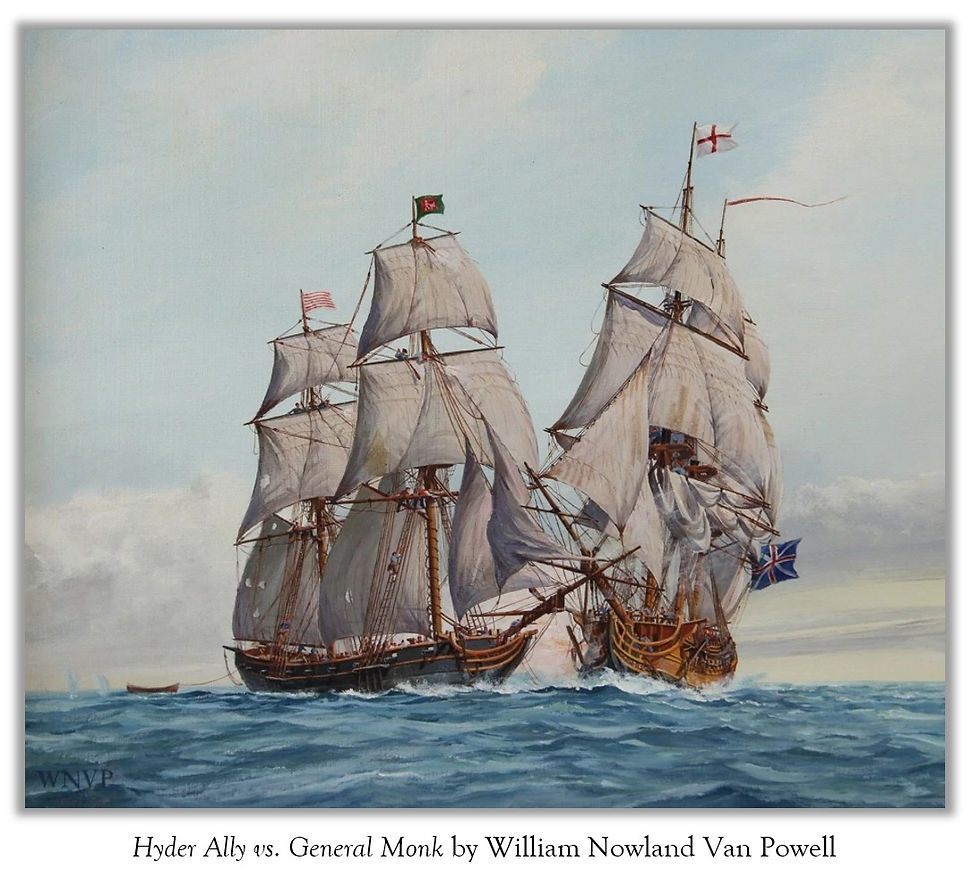
“Philadelphia set out to find a suitable vessel,” the U.S. Naval Institute explains, “one strongly built, large enough to go into action . . . fast enough to catch them . . . . [T]he only vessel offered for sale was the Hyder Ally, a tiny merchant ship . . . . unwarlike, she was the only one to be had, and she was bought.”
They armed the ship, then Joshua Barney of the Pennsylvania State Navy was commissioned as her captain.
By the morning of April 8, Hyder Ally was at the mouth of the Delaware, accompanying a merchant convoy with two other sloops. They’d been waiting for favorable winds when they spotted three British ships.
Barney directed the merchants back into the bay, with one sloop providing cover. That sloop ran aground, as did the British ship chasing her. Then the second sloop ran aground also. HMS Quebec moved to block the mouth of the bay, leaving Hyder Ally alone with HMS General Monk. The British ship was armed with twenty 9-pounders and four 6-pounders, whereas Hyder Ally had only sixteen 6-pounders.
Barney thought fast, ordering guns loaded but gun ports closed. Could he convince the British that he was unarmed until the last minute?
Only when he drifted into firing range did he act, firing a broadside of “grape, canister, and round shot.” But Barney’s tricky maneuvers were just beginning. “I am going to shout out my next order for the benefit of the enemy,” he told his helmsman, “but follow my next order by the rule of the contrary.”
“Hard–a-port your helm,” Barney ordered loudly as the two ships drifted toward each other. The British captain heard Barney yelling and directed his ship accordingly, expecting to turn away from Hyder Ally.
But the American helmsman steered contrary to Barney’s order, as instructed. The two ships collided, and Barney’s men promptly lashed the ships together.
“Prepare to board!” Barney yelled loudly, prompting the British captain to organize against boarding Americans. But Barney’s men were going by the rule of opposites, so they began firing instead of boarding.
Soon, Barney was yelling “Fire broadsides!” His men boarded General Monk instead, leaving the British flummoxed. They floundered in the hand-to-hand battle that followed and surrendered quickly.
Barney had one last trick up his sleeve to stave off HMS Quebec, still guarding the mouth of the bay. He left the British flag flying over the bound ships. Using General Monk’s signal book, Barney flashed a British victory to Quebec.
Quebec never knew that General Monk needed her aid.
The battle had not gone well for the British, who suffered 20 killed and 33 wounded. By contrast, Hyder Ally had 4 dead and 11 wounded.
The conflict was among the last of our Revolution, occurring after Washington’s victory at Yorktown but before a peace treaty. But isn’t it representative of the whole war?
Americans, supposedly outclassed by a superior British Army, winning when we were “supposed to” lose. And doing it all through sheer determination, a desire for freedom—and maybe a dose of ingenuity, too.

Primary Sources:
Bob Ruppert, Joshua Barney’s Victory in Delaware Bay (Journal of the American Revolution; June 7, 2016)
Captain Joshua Barney wins the Battle of Delaware Bay (California Society, Sons of the American Revolution; April 8, 2024)
J. Fenimore Cooper, History of the Navy (1839) (Vol. 1)
Joshua Barney (National Park Service)
Louis Arthur Norton, A Victory—‘By the Rule of the Contrary’ (Naval History Mag., April 2004) (reprinted HERE)
Louis Arthur Norton, Joshua Barney, the Hyder-Ally‘s Triumph, and its Aftermath (Journal of the American Revolution; Oct. 17, 2019)
Lieutenant Commander Thomas J. Cutler, U.S. Navy (Retired), Brilliance Over Brawn (U.S. Naval Institute Proceedings; Dec. 2008) (reprinted HERE)
M. V. Brewington, The Battle of Delaware Bay, 1782 (USNI Proceedings; Feb. 1939) (reprinted HERE)
NH 56478 HMS General Monk (Naval History and Heritage Command)
Comments