


This Day in History: Congress flees Philadelphia
On this day in 1776, the Continental Congress flees Philadelphia, fearing a British advance. Things had not been going well for the Patriot cause.
“From the last week of August to the last week of December,” historian David McCullough writes, “the year 1776 had been as dark a time as any in the history of the country.”
Indeed, the Continental Army was reeling from a series of crushing defeats: Losses at Brooklyn Heights, New York City, and White Plains had sent American forces retreating across New York and into New Jersey, with British General William Howe in hot pursuit.
Washington’s men had narrowly escaped across the Delaware River, but no one knew how Howe would respond.
Would he descend upon Philadelphia? Congressional delegates could not stick around to find out. They left, taking the Declaration of Independence with them and delegating “full power to order and direct all things relative to the department, and to the operations of war” to General Washington.
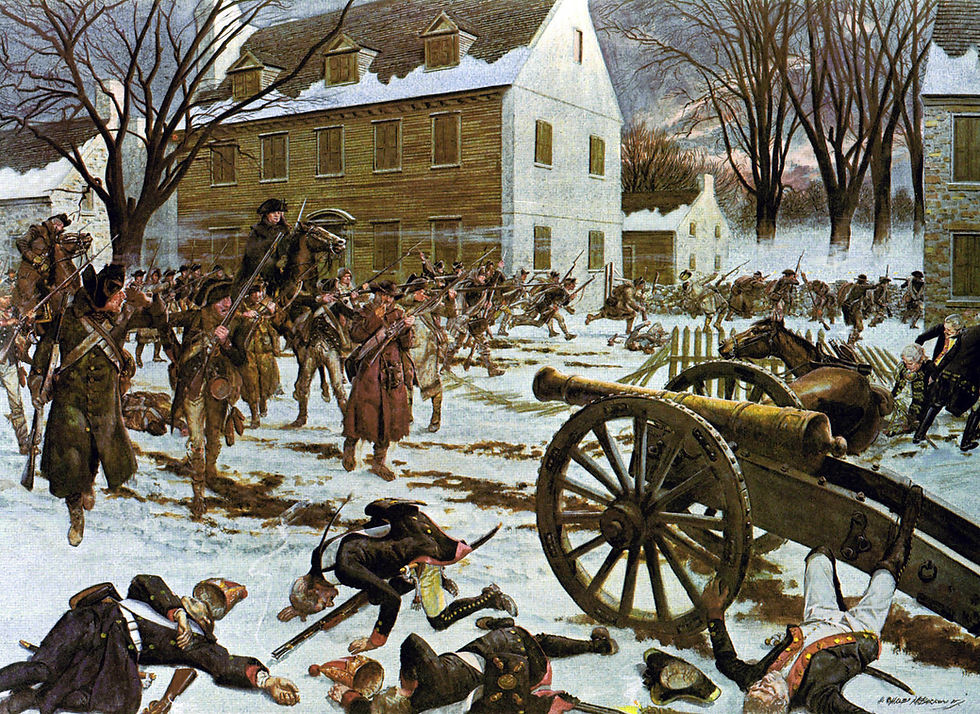
What was going through their minds, with things looking so bleak mere months after they’d signed the Declaration? “We must all hang together, or most assuredly we shall hang separately,” Benjamin Franklin reportedly said as that document was signed. Was it beginning to seem that they would, indeed, be hanged? Would the fight for independence be lost so soon? Would the risks they’d taken all be for nothing?
It is easy for modern Americans to forget just how scary some of these moments must have been. We already know the ultimate outcome of the American Revolution. But these men fleeing Philadelphia could not see into the future.
How telling that these delegates entrusted so much to Washington in those moments, given everything that must have been going through their heads.
As it would turn out, fleeing Philadelphia was unnecessary. The weather was worsening, and British General Howe decided to retire to winter quarters in New York City, leaving behind a series of outposts in New Jersey.
Howe couldn’t then know it, but his decision would provide Washington with the opportunity he was looking for: A Christmas-time midnight Delaware crossing combined with a surprise attack on the forces Howe had left at Trenton.
Howe wasn’t the only one in the dark: Congressional delegates didn’t know what Washington had up his sleeve, either. After fleeing Philadelphia, they’d reconvened in Baltimore, where they decided to double down on trusting Washington “with full ample and complete Powers” over various military matters, noting their “perfect Reliance on the Wisdom, Vigour, and Uprightness of General Washington.”
They wrote those words on December 27, not realizing that Washington had already achieved a much-needed victory at Trenton just one day earlier.
How relieved they must have been when word of the victory arrived in Baltimore! And they must have been even more stunned when the victory at Trenton was followed by another at Princeton on January 3.
“The campaign of 1776 had ended with a second astonishing victory,” McCullough concludes. “Had Washington been born in the days of idolatry, declared the Pennsylvania Journal, he would be worshipped as a god. . . . some on the British side grudgingly conceded that the ‘rabble’ must henceforth be regarded with new respect.”
Once again, one is left wondering what Americans would have done without George Washington.
Enjoyed this post? More Revolutionary War
stories can be found on my website, HERE.
Primary Sources:
Continental Congress leaves Philadelphia fearing British invasion (California Society; Sons of the American Revolution; Dec. 12, 2022)
David McCullough, 1776 (2005)
Journals of the Continental Congress, 1774-1789 (Vol VI: 1776)
Letter from George Washington to John Hancock (Dec. 27, 1776)
Letter from John Hancock to George Washington (Dec. 27, 1776) (including resolutions enclosed for Washington)
The Declaration of Independence: A History (National Archives)
Comments